One-on-one time with each of four kids: a rotation that fits a real week
Every parenting book says the same true thing: each child needs time alone with you. With four kids, that sentence is not advice, it is an arithmetic problem. Four children, one or two parents, and evenings that are already spoken for. The parents who make individual time happen are not the ones with more love or more hours, they are the ones running a rota instead of relying on good intentions. This guide builds that rota: a short daily practice scaled to four kids, one named night per child, formats matched to each age, and a restart rule for the weeks, there will be weeks, when the whole thing collapses.
Why good intentions lose to arithmetic
Do the honest total first. The best-known version of individual time is "special time": 5 to 10 minutes a day with a single child, in play the child leads, a practice developed by psychologist Dr. Sheila Eyberg in the 1970s. For one child, that is a rounding error in a day. For four children, done daily, it is 20 to 40 minutes of fully focused, phone-free, one-at-a-time attention, every day, on top of homework, dinner, and bedtime. That is still achievable, but only if it is scheduled like the non-negotiable it is supposed to be. Unscheduled, it competes with everything urgent and loses to all of it.
The second piece of arithmetic is fairness. Equal minutes are the wrong target: babies and toddlers genuinely need more parent time than older children, and a teenager's 20 minutes of real conversation can outweigh an hour of parallel play. The rota's promise to each child is not "the same", it is "yours is coming, it is on the calendar, and it does not get traded away."
The two-tier system: daily minutes plus a named night
One tier alone fails. Daily minutes alone feel thin to an older child; a weekly outing alone is too easy to postpone. Run both:
Tier 1, daily special time (5–10 minutes per child). Short, child-led, at home, costing nothing. The child chooses the activity and leads it; the adult's job is attention, not direction. Families have run a version of this for centuries, one documented historical pattern set aside a portion of each evening to talk with one child apart, rotating through the children night by night, and the rotation is exactly what makes it survivable at scale.
Tier 2, the named night (one child per night, 20–30 minutes). Each child gets one evening a week that is theirs by name, "Maya's night", with a slightly longer block: a walk, a board game, a hot chocolate run, shooting hoops, a shared project. Four kids, four nights; the remaining nights are buffer for the week that inevitably goes sideways. When two parents are home, the tiers multiply: one parent can run a named night while the other covers the rest of the house, and the parents swap children the following week so every child gets time with both.
How special time actually works
The rules are stricter than "hang out," and the strictness is the point. The child leads, chooses the activity and directs the play, as long as it is safe. The adult does not teach, correct, quiz, or steer, and screens do not count as special time. NHS guidance on special time makes the same core point: play where the child is in control supports development, strengthens the parent-child relationship, and tells the child they have your full attention. Seattle Children's coverage of the practice summarizes the adult's skills with the acronym PRIDE: specific praise, reflecting the child's words back, imitating their play, describing what they are doing without judging it, and visible enthusiasm. Reported benefits include stronger bonding, improved listening, fewer disruptive behaviours, and better social skills, and the research summary is honest that a few times a week still helps when daily is impossible.
The rotation, step by step
Step 1, assign the nights. Write each child's name beside one weekday, in an order that respects real life: the child with early practice gets the early-evening slot, nobody's night sits on the family's worst night. Post the rota where everyone can see it. Visibility is enforcement, a child who can see their night coming does not have to compete for it.
Step 2, anchor Tier 1 to an existing routine. Attach the daily minutes to something that already happens: right after dinner, during the bedtime wind-down, on the walk to school. Piggyback time counts too, large-family guidance is blunt that one-on-one time can be a conversation while folding laundry or a quick game before bed; simple and consistent beats elaborate and rare. Errands run with one child, a drive with one passenger, a chore done as a pair: all of it is rota time if the child knows it is theirs.
Step 3, let the child choose, within a menu you can afford. The child picks the activity; the parent sets the boundaries in advance (at home or nearby, within the time block, no screens for Tier 1). A toddler chooses between blocks and a picture book; a teen chooses the walk, the drive, or the late-night kitchen chat.
Step 4, protect the block. Timer on, phone in another room, siblings briefed (see below). End on time and say when the next one is. A predictable ending is what makes a short block feel generous instead of interrupted.
Step 5, log it in one line. A tick beside each name on the rota. The log is not bureaucracy; it is how you notice that the quiet middle child has been skipped twice before they have to act out to tell you.
What success looks like: every child can answer the question "when is your time?" without hesitating, turns end on time without negotiation, and missed nights get rescheduled in the same conversation that cancels them.
Match the format to the age
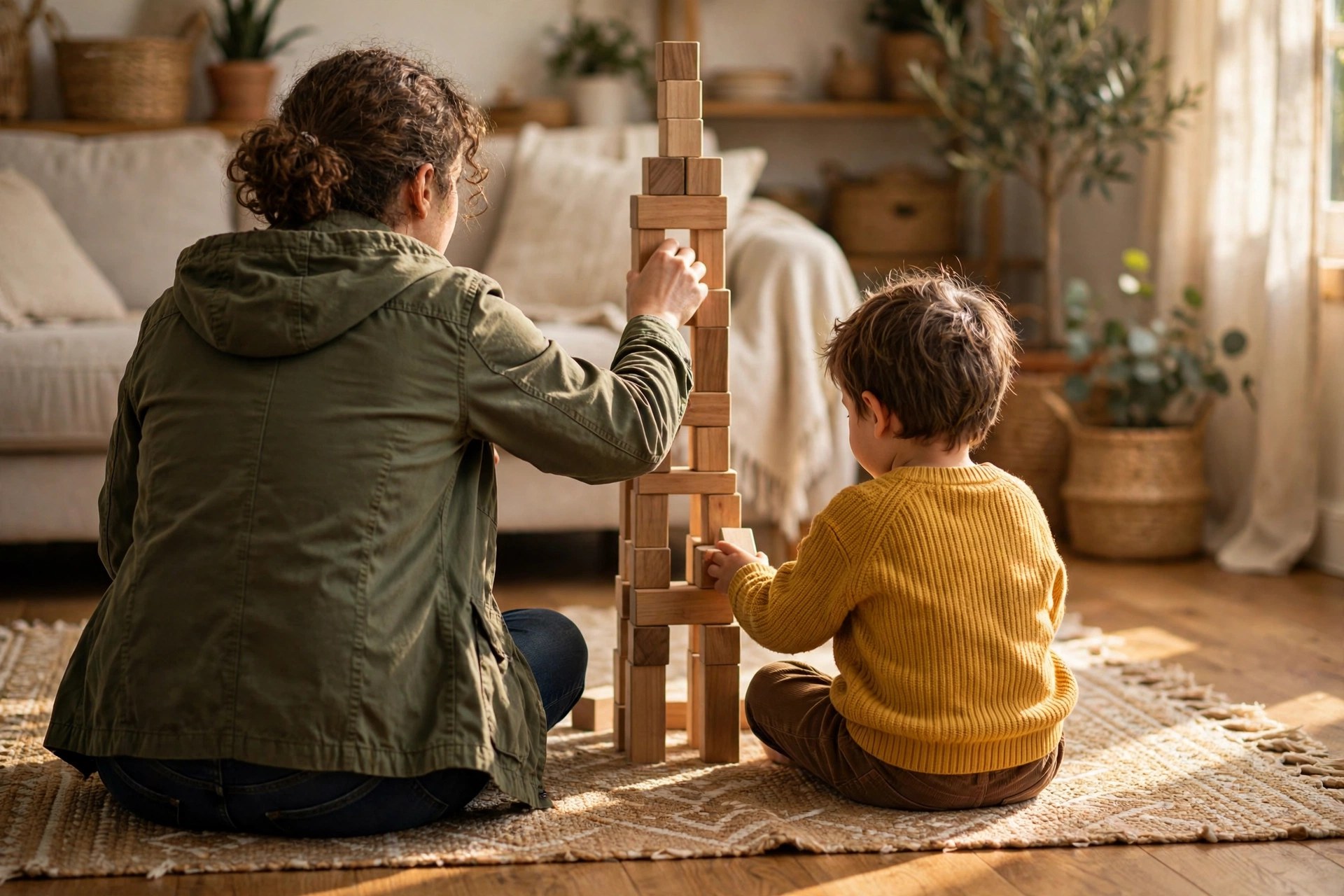
- Ages 3–7: keep it to 5–15 minutes of child-chosen imaginative play, blocks, drawing, dolls, with a timer and a gently announced ending. Stay physically close, narrate and praise specifically, and let them be the expert.
- Ages 8–12: stretch to 20–30 scheduled minutes around a shared, side-by-side activity, shooting hoops, a walk with the dog, a simple project, a shared podcast. Side-by-side beats face-to-face at this age: conversation flows when nobody is being looked at, and the adult's job shifts to listening and reflecting feelings rather than advising.
- Teens: the format becomes company, not play. A drive, a food run to a favourite place, a late kitchen conversation, scheduled activities inside or outside the home both work. Offer the slot on the rota and let the teen shape it; a teen who declines the activity but keeps showing up in the kitchen at 9 p.m. is telling you what their format is.
What the other three do during a turn
This is the part nobody writes about, and the part that kills rotas. Three workable answers, by age mix: parallel special time, when two parents are home, both run a turn at once, so two children are covered and only two are waiting; a waiting activity with status, the waiting children get something genuinely good (the coveted puzzle, audiobook time, the first turn at the next thing), not a holding pen; and bedtime sequencing, run turns as part of the bedtime stagger, so the "waiting" children are already in bed with a book while the next child's turn happens. What does not work: telling three children to "just wait quietly nearby." Build the waiting into the plan, or the rota will be sabotaged by the entirely reasonable protests of the unoccupied.
When the week collapses: the restart rule
Illness, overtime, a flooded basement, some weeks the rota simply dies. The rule that saves it: never owe a child a double. Back-pay creates a debt spiral that makes restarting feel impossible. Instead, the missed child gets the first slot when the rota restarts, the restart is announced out loud ("rota is back on Thursday"), and the system resumes at normal size. A rota that restarts small and immediately beats a grand relaunch scheduled for a calmer month that never comes.
General parenting information only, not professional or therapeutic advice. Families dealing with persistent behavioural or relationship difficulties should talk to a qualified professional, special time is a connection habit, not a treatment.
FAQ
Is 5 minutes really enough to matter?
The special-time practice was built on 5 to 10 minutes daily, and benefit
is reported even a few times a week. What makes it work is not duration, it is that the child leads, the attention is undivided, and it keeps
happening. Ten reliable minutes beat a monthly grand outing that keeps
being postponed.
Should each child get exactly the same amount of time?
No. Younger children typically need more parent time, and different ages
use time differently. Promise each child a predictable, protected turn, not identical minutes. Predictability is what children experience as
fairness here.
What if a child keeps choosing screens?
Special time, by definition, excludes screen time, the child leads within
boundaries the parent sets in advance. Offer the menu (play, walk, game,
talk, project) and let them choose freely inside it.
Can grandparents or another adult run a turn?
Yes, scheduled one-on-one activities with a trusted adult still give a
child undivided attention, and large-family guidance explicitly encourages
a tag-team approach among the adults in the house. Parent turns remain the
core of the rota; extra adults expand it, they do not replace it.