Grocery shopping for a family of six on a budget: start with the math
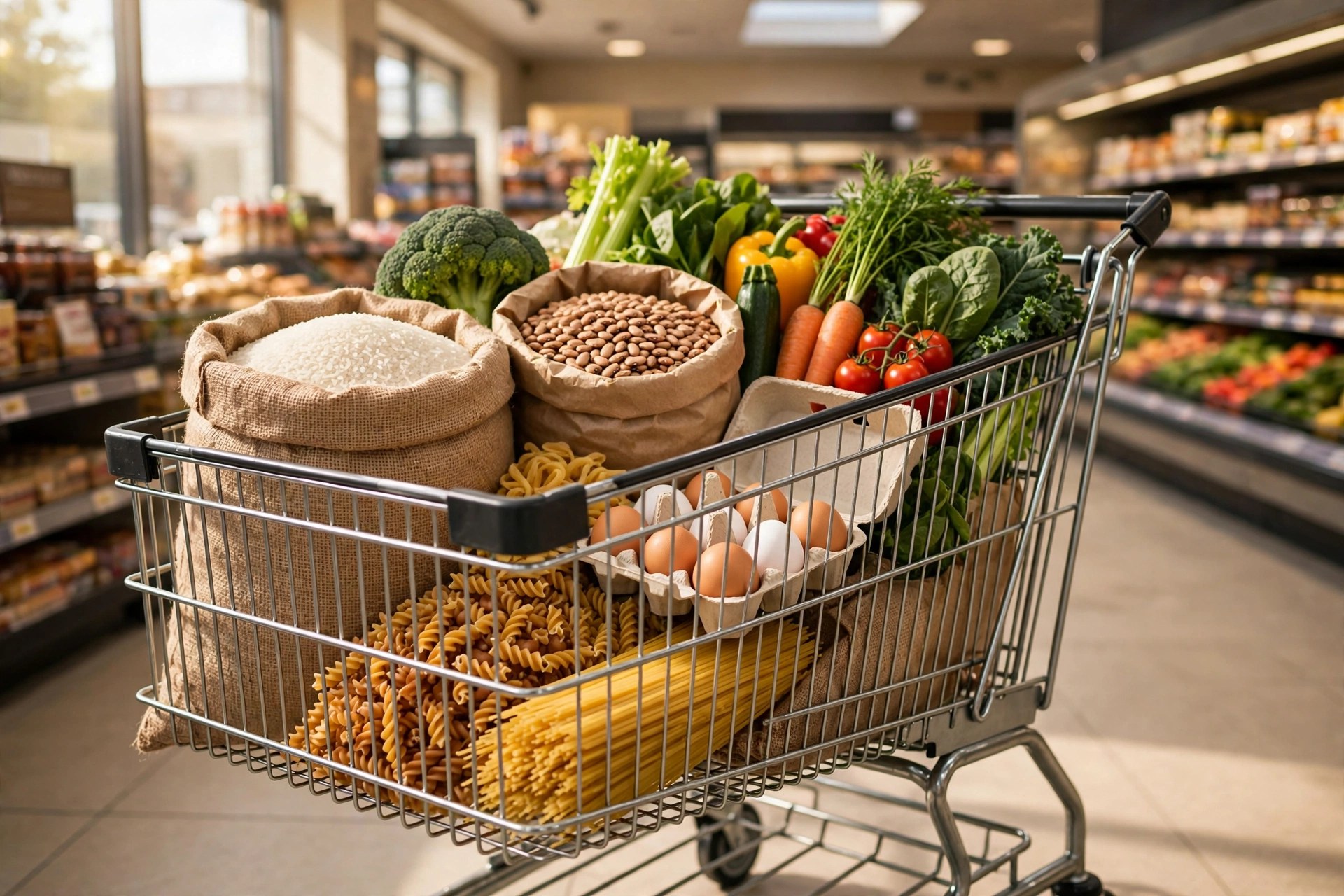
Most grocery advice for big families is a pile of tips: buy in bulk, shop the flyers, freeze everything. Tips are not a budget. A budget is a number you can hold a receipt up against, and for a family of six, almost nobody publishes that number. This guide builds it from a published benchmark, then gives you the weekly system that keeps a real household of six near it: a bulk-buying test, a cost-per-serving check, and a planned place for leftovers so food you paid for actually gets eaten.
Start with the benchmark, not the vibes
Canada's Food Price Report 2026 projects that a typical four-person household will spend $17,571.79 on food in 2026, roughly $994.63 more than the year before, with food prices reported as about 27% higher than five years earlier. Divide the annual figure by twelve and by four people and you get the working benchmark: about $1,464 a month, or $366 per person per month, for a nutritious but typical diet. Frugal households shopping store brands and flyer deals can land below that figure; organic, specialty, or allergy-driven buying pushes well above it. The benchmark is a yardstick, not a verdict, but without a yardstick, every grocery bill just feels "too high" and nothing ever gets fixed.
One caution before the math: benchmarks describe food eaten at home. Takeout, school cafeteria days, and the pizza that rescues a collapsed Tuesday are real spending, but they belong in a separate line. Mixing them into the grocery total makes the grocery system look broken when it is actually the rescue meals doing the damage.
The six-person math: what feeding everyone actually costs
Here is the total-cost calculation for a household of six, using the benchmark above. This is arithmetic on a published figure, not a published six-person figure, treat it as a planning estimate and adjust it against two or three months of your own receipts.
- The naive total: 6 people × $366 per person = about $2,196 a month (roughly $507 a week). This is the ceiling most families of six should compare against first.
- The scale adjustment: per-person grocery cost falls as household size grows, because staples like oil, spices, rice, and flour are split more ways. Published household-size tables show the per-person figure dropping at each step from one person to five-plus. Applying a modest 5–10% scale discount to the naive total gives a realistic planning band of roughly $1,975–$2,085 a month for six people eating a typical diet at home.
- The waste adjustment: a Love Food Hate Waste / FoodMesh study of more than 8,000 Canadians estimated that 47% of all food in Canada is wasted annually, that households generate about 15% of that waste, and that roughly two-thirds of household food waste is avoidable. Run the illustrative math on a $2,000 monthly spend: if even 5% of what enters the house is thrown away uneaten, that is $100 a month, $1,200 a year, spent on garbage. Cutting avoidable waste is usually the cheapest "raise" a grocery budget can get, because it needs no new recipes and no cheaper food, just a plan for the food already bought.
Pick your band, write it at the top of the shopping list, and judge the month against it. A single expensive week proves nothing; three months above the band means the system, not your willpower, needs a change.
Bulk buying: the winners, the losers, and the waste test
"Buy in bulk" is only half a rule. The other half is knowing what bulk buying quietly loses money on. Before any bulk purchase, run the waste test: will all of this be used, in normal meals, well before it goes stale or expires, and is there somewhere to store it? If the honest answer needs the word "probably," it is not a saving, it is a gamble.
| Category | Usually wins in bulk | Usually loses in bulk |
|---|---|---|
| Dry staples | Rice, pasta, dried beans, oats, flour, cheap per serving and slow to spoil | Specialty grains or flours bought for one recipe and never opened again |
| Protein | Meat that gets portioned and frozen the day it comes home; eggs, lentils | Fresh meat or fish with no freezing plan for the same day |
| Produce | Frozen vegetables and fruit; seasonal fresh produce the plan already uses | Large fresh produce with no specific meal planned for it |
| Household | Cleaning supplies and paper products the house uses constantly | Anything being tried for the first time, in the largest size |
The pattern underneath the table: bulk wins when the item is a base, an ingredient that disappears into soups, casseroles, stir-fries, and baked pasta, the stretch meals that feed six people from modest amounts of protein. It loses when the item is an event, bought for one dish, one craving, or one child's current phase. Track how long a bulk package actually lasts the first time; that one observation is worth more than any per-unit price tag.
Judge meals by cost per serving
Sticker price lies to big families. A large roast can cost less per serving than a small pack of convenience food that feeds four people once. The fix is one habit: divide the meal's ingredient cost by the number of servings it actually produced. Working targets used by large-family planners run around $2–3 per person for dinner, with cheaper lunches and breakfasts below that. You do not need to cost out every meal forever, cost out your ten most-cooked dinners once, write the per-serving figure beside each one, and you will know permanently which "cheap" dinners are not, and which pricier-looking ones quietly feed six people twice.
The weekly system, step by step
This is the operating loop. It takes about half an hour of planning to protect five hundred dollars of shopping.
Step 1, pantry and freezer first (10 minutes). List what is already in the house that needs using: the half-bag of lentils, the frozen chicken, the wilting peppers. This week's plan is built around those items first, so nothing bought last week becomes this week's waste.
Step 2, set the week's number. Take your monthly band, divide by four, and write the week's ceiling at the top of the plan. The plan is built to fit the number, not the other way round.
Step 3, plan seven dinners on the template. A rhythm that survives real weeks: one batch-cooking day, one slow-cooker day, one stretch meal (soup, chili, casserole, or stir-fry), one or two meatless dinners built on beans, lentils, or eggs, one leftover-transformation night, one family favourite, and one flexible night. Roast chicken on Sunday becoming tacos, soup, or sandwiches by Wednesday is the template working as designed.
Step 4, write the list from the plan, in store order. Only ingredients the plan needs, plus staples that have actually run out. Store brands are the default where the family cannot taste a difference; homemade spice blends beat pre-made packets on cost for the meals you cook weekly.
Step 5, one main shop, one small top-up. The main shop covers the plan. A single midweek top-up for milk, bread, and fresh produce is allowed; a third trip is where budgets leak, because nobody leaves a grocery store with only milk.
Step 6, the five-minute waste check. Once a week, before the main shop, look at what got thrown away. One repeated item, the salad kit, the bulk berries, is a planning error with a name. Shrink it, freeze it, or drop it from the list.
What success looks like: the month lands inside your band, the fridge empties toward the end of the week instead of expiring, and dinner is a decision made on Sunday, not a negotiation held at 5:30 p.m. in front of an open fridge.
Where the plan leaks
Three leaks account for most overspending at six-person scale. First, unplanned protein: meat is the biggest single driver of food-price increases, so the meatless nights and the stretch meals are load-bearing, not virtuous extras. Second, best-before confusion: only 40% of Canadians surveyed knew that best-before dates do not necessarily relate to food safety, food discarded on a date alone is often food that was still fine, which is the waste budget leaking through the calendar. Third, four kids' worth of snack drift: six people's worth of grazing, none of it on the list. The fix is boring and effective, plan the snacks (popcorn kernels, oats, fruit in season) with the same seriousness as the dinners.
General information only, not financial advice. Benchmarks are national projections; your local prices, dietary needs, and store access will move your real number. Adjust the band against your own receipts.
FAQ
Is the family-of-four benchmark useless for a family of
six?
No, it is the best published yardstick available, as long as you scale it
honestly: multiply per person, then apply a modest scale discount because
per-person costs fall as households grow. Label the result an estimate and
correct it with your own receipts over two or three months.
Should a family of six shop at a warehouse store?
For the bulk winners, dry staples, freezable protein, frozen produce,
paper goods, usually yes. For fresh produce without a plan and first-time
items, the warehouse is where good budgets go to spoil. Run the waste test
on every oversized item.
What is the fastest single saving?
The planned leftover night. It costs nothing, needs no new skills, and
directly attacks the avoidable share of household food waste, for most
families a larger saving than any coupon habit.
How many dinners should be meatless?
One or two a week is the common planning advice, built on beans, lentils,
and eggs. At six servings a dinner, swapping even one meat dinner a week
moves the monthly protein line noticeably.